
描述
Operation manual of Rock Free Swelling Rate Testing Meter
Ⅰ. Technical parameter:
- Dial gauge: 1mm, 0.001mm;
- Precision: 0.001mm;
- Glass tank: 85mm(L) ×85mm(W) ×80mm(H);
- Porous disc: 60mm ×60mm;
- Specimen size: φ60×20mm/60×60×20mm;
- Out Frame dimension: 200mm ×100mm × 195mm.
Ⅱ. Summary of Rock Free Swelling Rate Testing Meter
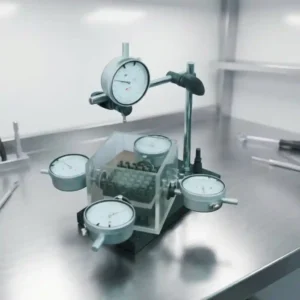
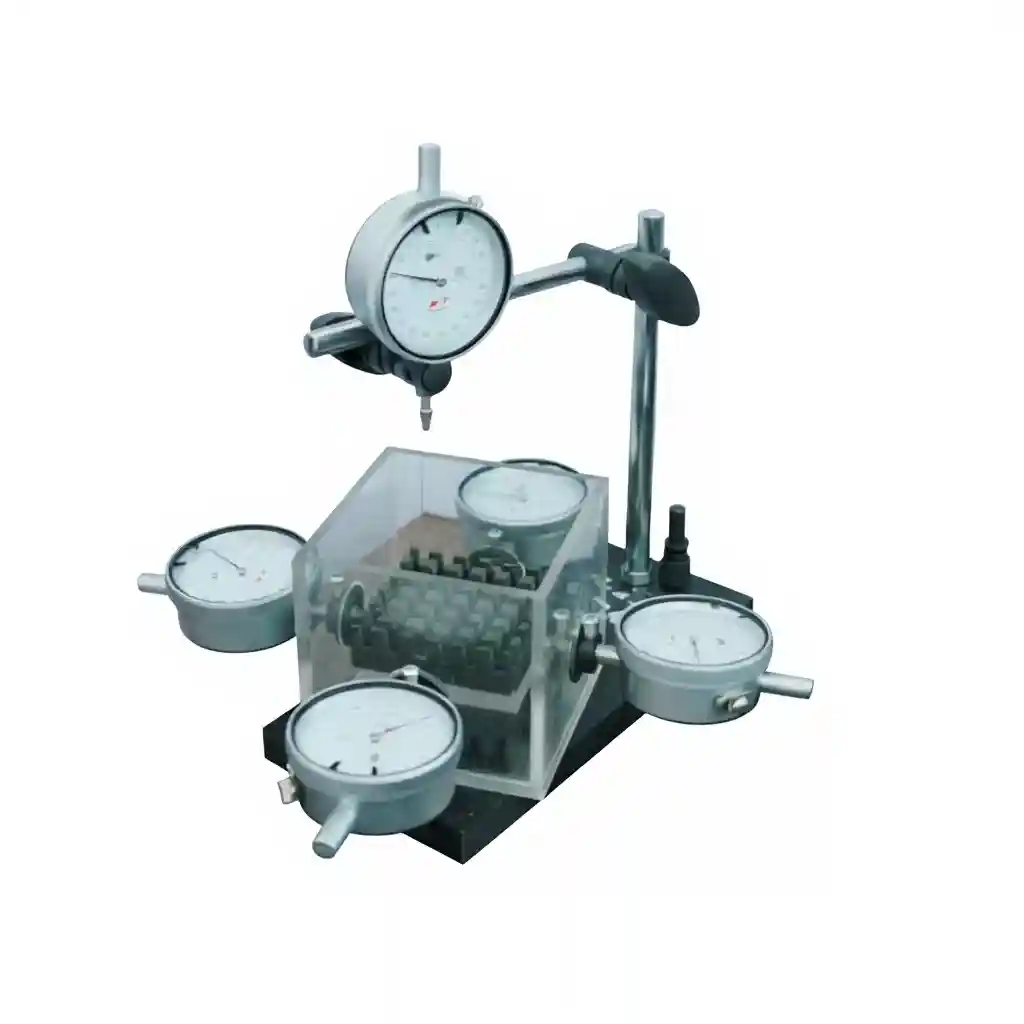
This testing instrument is a digital direct reading structure with a dial gauge, suitable for testing displacement changes in various directions without constraints in various rock swelling tests. It is equipped with testing devices such as permeable plates and dial gauges.
Ⅲ. Operation Instructions:
- Preparation of rock specimen’s size: The ratio of diameter (R) andheight (H) of the rock specimen is ≥ 2.5 :1. According to the requirements of the testing machine mold, the sample is:R=φ60mm, H=20mm, or 60*60mm,H=20mm.
- Place the lower permeable plate(Porous disc) in the center of the water tank. And lay a layer of thin filter paper on top.
- Place the rock specimenon filter paper and lay a layer of filter paper on top of it. Then place the upper permeable plate on them.
- Gently fix thefour dial gauges around the glass groove, so that each dial indicator is pre pressed to a certain value of about 0.2mm. (Apply butter or glass glue to the entire rod and measuring head of the dial gauge to prevent water from entering and rusting).
- Adjust the fifth dial gauge on the support to the upper end of the test block, adjust the dial gauge to pre compressto a certain value of about 0.2mm. (Place the entire tankon the lower platform of the measuring bracket).
- Record the dial gauge reading every 10 minutes until it remains unchanged for three consecutive readings.
- Slowly inject distilled water into the glass tank until the upper permeable plate is submerged and immediately take a reading.
- Within the first hour, measure the deformation every 10 minutes, and then record the data every hour until the difference between the adjacent three data is ≤ 0.001mm, which is considered stable. However, the immersion test time should not be less than 48 hours.
- The water level should be kept constant throughout the entire test process, and the temperature change should not exceed 2 ° C.
10. After the experiment, a detailed description of the disintegration, cracking, rapid falling, and surface mud or softening of the specimen should be provided.
Ⅳ. Routine maintenance of instruments
- If the water tank leaks, seal the connection of the glass tank with glass glue and let it cool for at least 3 hours before use.
- Ensure that the upper part and surrounding area of the dial gauge are dry or impermeable, and wipe dry promptly if there is water.Be careful during installation and testing.
- After each test, remove the dial indicator and apply oil for maintenance.